by Grayson Chong
Act I: Setting the Stage
I’ll use that tongue I have. If wit flow from’t
As boldness from my bosom, let’t not be doubted
I shall do good. (2.2.53-55)
On November 16th, 2025, a friend and I attended The Winter’s Tale, choreographed by Christopher Wheeldon and performed by National Ballet of Canada. Although I have long been immersed in ballet as both a performer and audience member, this was the first time I had seen a ballet adaptation of a Shakespearean play. To witness a work that I have taught my students in the past translated into movement was particularly exciting.
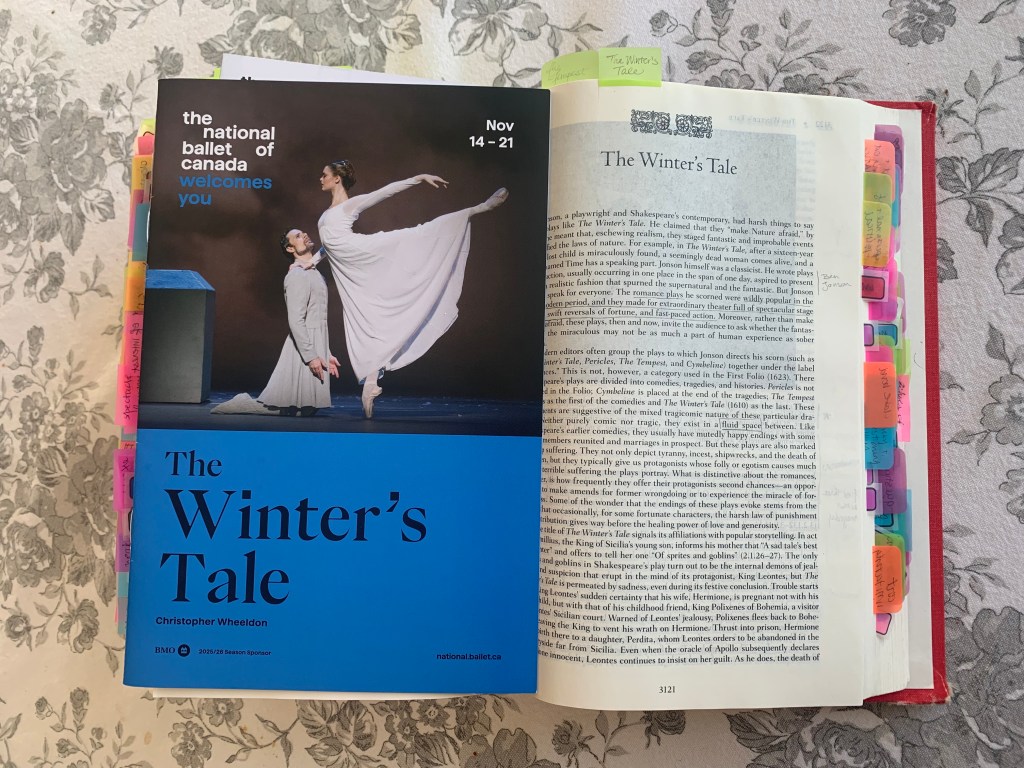
Photo by Grayson Chong.
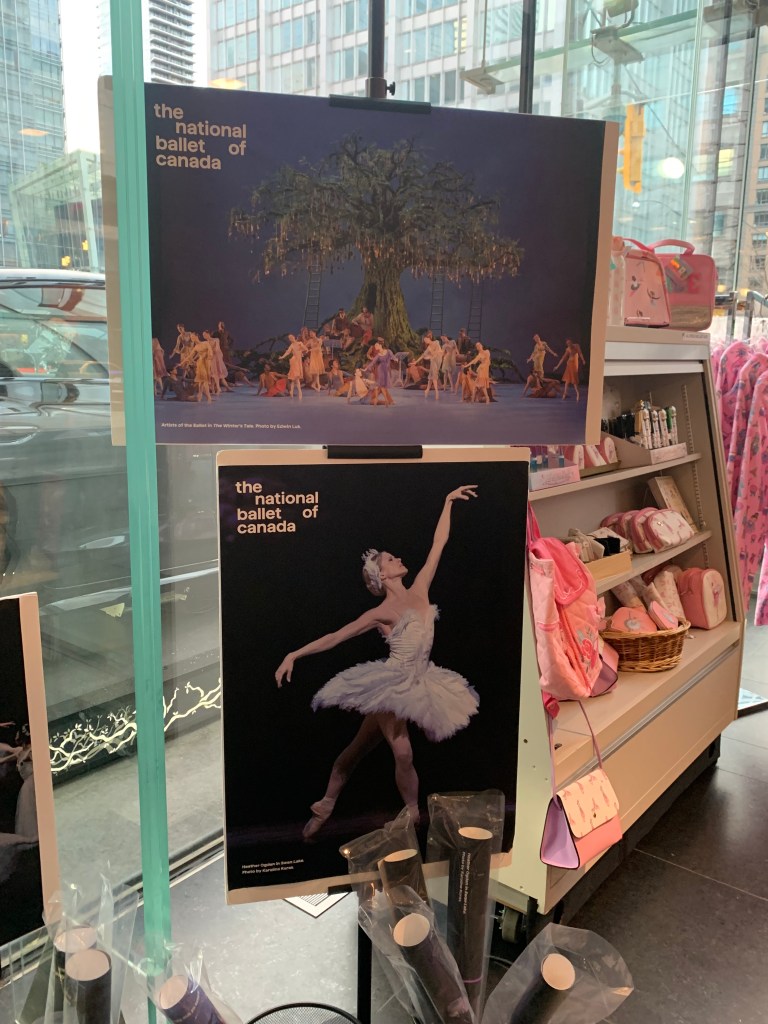
Four Seasons Centre for the Performing Arts. Photo by Grayson Chong.
The Winter’s Tale originally premiered in 2014 at the Royal Ballet Opera House in London.1 The National Ballet of Canada first performed Wheeldon’s production in November 2015 and returned to the Four Seasons Centre for the Performing Arts in Toronto ten years later. Divided into three acts, the play explores loss and redemption beginning with the fallout between two kings and lifelong friends, Leontes of Sicilia (Ben Rudisin) and Polixenes of Bohemia (Donald Thom) when Leontes believes his wife Hermione (Isabella Kinch) and Polixenes are having sexual relations. This results in Leontes accusing Hermione of treason and adultery and her false imprisonment; the deaths of Hermione and their son Mamillius; and the abandonment of their newborn daughter who is left in the shores of Bohemia. Sixteen years later, the child Perdita (Tirion Law) falls in love with Prince Florizel, Polixenes’s son (Naoya Ebe). The couple flees to Sicilia when Polixenes finds out about their engagement only for it to be discovered that Perdita is the long-lost daughter of Leontes and Hermione. Paulina, Hermione’s lady-in-waiting (Heather Ogden), reveals a statue that looks like Hermione which comes to life.2 The two families reunite to celebrate Perdita and Florizel’s marriage.3
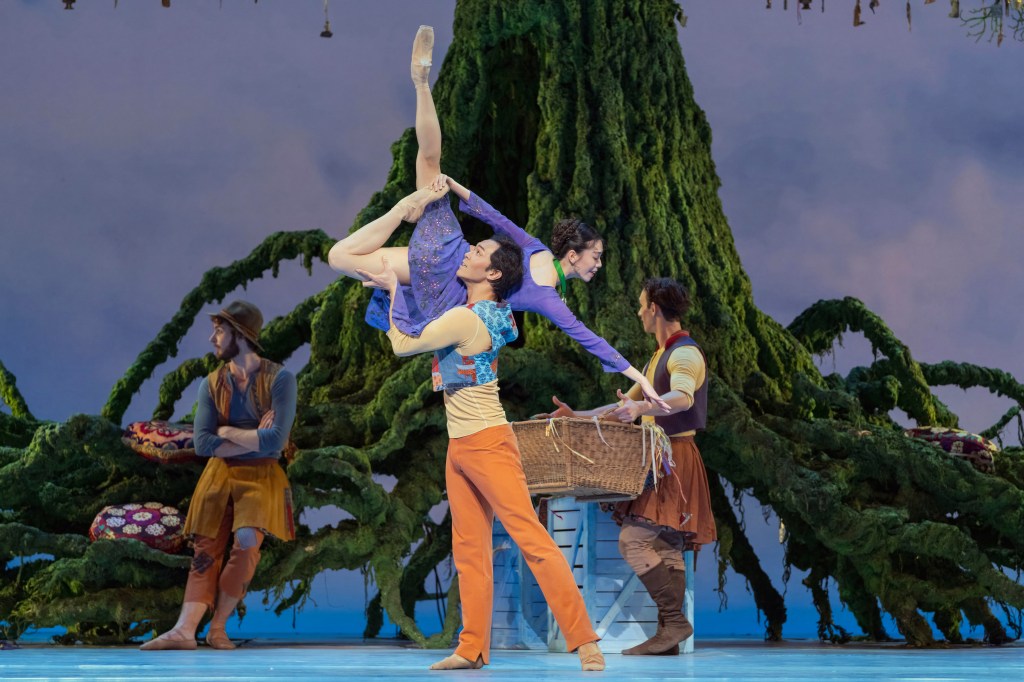
Photo by Karolina Kuras. Courtesy of The National Ballet of Canada.
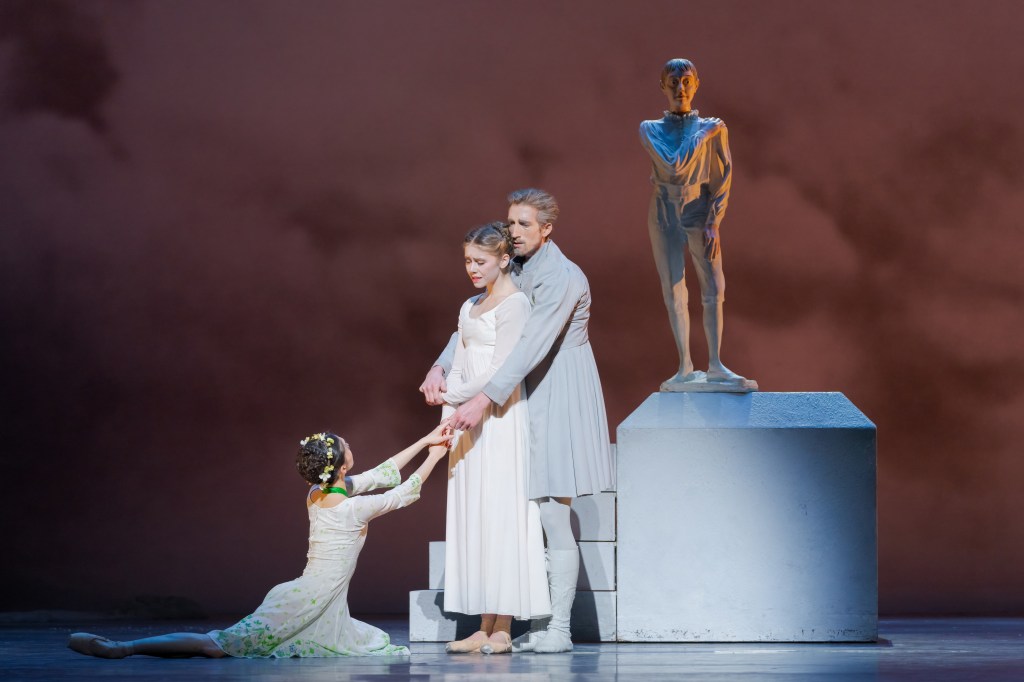
Photo by Karolina Kuras. Courtesy of The National Ballet of Canada.
Most dance scholarship on The Winter’s Tale has been written on Act II in Bohemia due to its lively choreography, pastoral setting, and the budding romance between Perdita and Florizel.4 Instead, my review focuses on Act I and Act III because I am struck by Wheeldon’s attention to narrative. More specifically, these acts spotlight Paulina who (in my opinion) becomes the main character of the production and the ballet’s governing presence. If the Bohemian Act II celebrates youthful love, the Sicilian acts stage the formation and reckoning of conscience.
In Shakespeare’s The Winter’s Tale, Paulina is often understood as the voice of reason and the timekeeper. In the ballet, Paulina’s body assumes this authority. She “use[s] that tongue” she has (read: the body) to speak to the audience. Her performance becomes what I understand to be the work of conscience in the production. By repositioning Paulina at the ballet’s structural and emotional centre, Wheeldon offers not just an adaptation of Shakespeare’s play but also a reinterpretation of its moral narrative.
This review reads the choreography alongside the play, attending to how Paulina takes centre stage in Wheeldon’s production. I should note that the play and choreography of The Winter’ Tale are completely different productions and should be treated as such. However, I look at the two productions together because witnessing the ballet performance has expanded the way I read the play (and subsequently how I teach this play to my own students). In this review, I focus on how Paulina’s function as conscience becomes intensified through movement in Wheeldon’s choreography.
Act II: Paulina and Leontes
Look down
And see what death is doing. (3.2.145-146)
In a review focused on Paulina, I begin by focusing on Leontes because his interactions with her define the ballet’s moral narrative. Notably, Paulina and Leontes are the only characters granted solos in Wheeldon’s production. In a full-length ballet, a solo functions like an inner monologue (or to use literary terms, a soliloquy). By reserving solos for these characters, Wheeldon reframes the narrative as psychological and moral drama rather than romantic production. Leontes’s solo externalized his destructive imagination as his jealousy and paranoia unravel his mind.5 The decision to give Paulina a solo equalizes her position with the king. She is not just Hermione’s lady-in-waiting nor witness to the events in Sicilia; she provides a counterpoint to Leontes.
In Act I, the audience witnesses Leontes imagining Hermione and Polixenes having sexual relations with each other, peering around statues to catch them in the act. We watch as Leontes expresses: “Too hot, too hot./ To mingle friendship far is mingling bloods./ I have tremor cordis on me; my heart dances,/ But not for joy, not joy” (1.2.108-111) with sharp movements as he imagines Hermione and Polixenes together, effectively destroying the lifelong friendship described by Camillo and Archidamus in Act 1 Scene 1 of the play:
CAMILLO: The heavens continue their loves.
ARCHIDAMUS: I think there is not in the world either malice or
matter to alter it. (1.1.27-28)
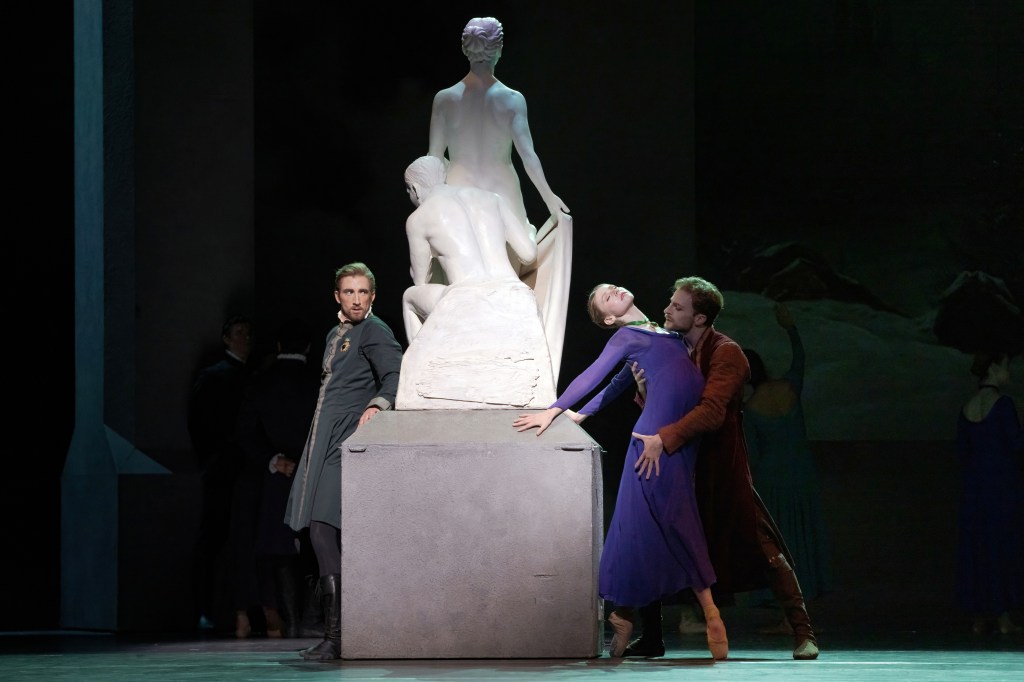
Photo by Karolina Kuras. Courtesy of The National Ballet of Canada.
Leontes reaches, coils, circles in suspicion. His movements shift between erratic chaînés and sweeping of his feet to deep pliés and spider-like movements with his fingers moving around his head and body to convey:
LEONTES: There may be in the cup
A spider steeped, and one may drink, depart,
And yet partake no venom, for his knowledge
Is not infected […]
I have drunk and seen the spider. (2.1.40-43, 46)
Aside from the combination of erratic and spider-like movements, I interpret Leontes’s elongated movements (a series of développés and à la seconde turns punctuated by grande jetés) as his mind reaching for proof that does not exist. Whereas Leontes’s movements unravel, Paulina’s movements anchor.
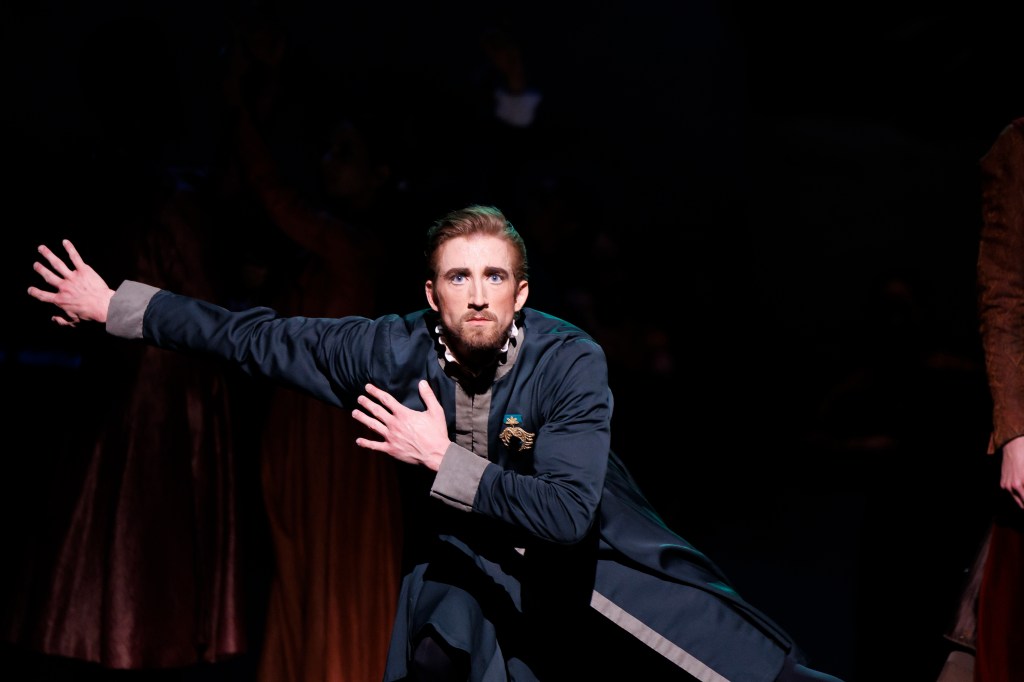
Courtesy of The National Ballet of Canada.
The scene shifts to Hermione with Mamillius and her ladies-in-waiting only to take a dark turn when Leontes storms into the room arresting Hermione on accounts of adultery and treason. Paulina, introduced in Act I of Wheeldon’s production, steps in to defend Hermione and brings the newborn baby to Leontes.6 When she assumes a moral position on stage and speaks for Hermione and the baby, we can recall her words in the play: “I’ll use that tongue I have. If wit flow from’t/ As boldness from my bosom, let’t not be doubted/ I shall do good” (2.2.53-55). However, the audience soon witness the death of Mamillius and Hermione, leaving Paulina to confront Leontes as if begging: “Look down/ And see what death is doing” (3.2.145-146). Shakespeare scholars know Paulina is a woman of many words, and Ogden as Paulina does all the talking. We watch Paulina hit Leontes to convey the rage and anger and injustice of the situation which seems to turn Leontes from a jealous tyrant to a remorseful king. However, the damage has already been done which leads Leontes to tell Paulina in the play:
LEONTES: Prithee bring me
To the dead bodies of my queen and son.
One grave shall be for both. Upon them shall
The causes of their death appear, unto
Our shame perpetual. Once a day I’ll visit
The chapel where they lie, and tears shed there
Shall be my recreation. So long as nature
Will hear up with this exercise, so long
I daily vow to use it. Come, and lead me
To these sorrows. (3.2.231-240)
And Paulina fulfills this order.
Fast forward in Time to Act III, Paulina, dressed in black to communicate grief, slowly carries Leontes across the stage to the statues of Hermione and Mamillius for what Wheeldon describes as “Leontes’s mourning worship to the grave”.7 Leontes is bent almost at a 90-degree angle, his head resting in Paulina’s hand while she remains upright. The visual hierarchy is unmistakable. Though politically subordinate to Leontes, she is physically and ethically elevated in Wheeldon’s production.
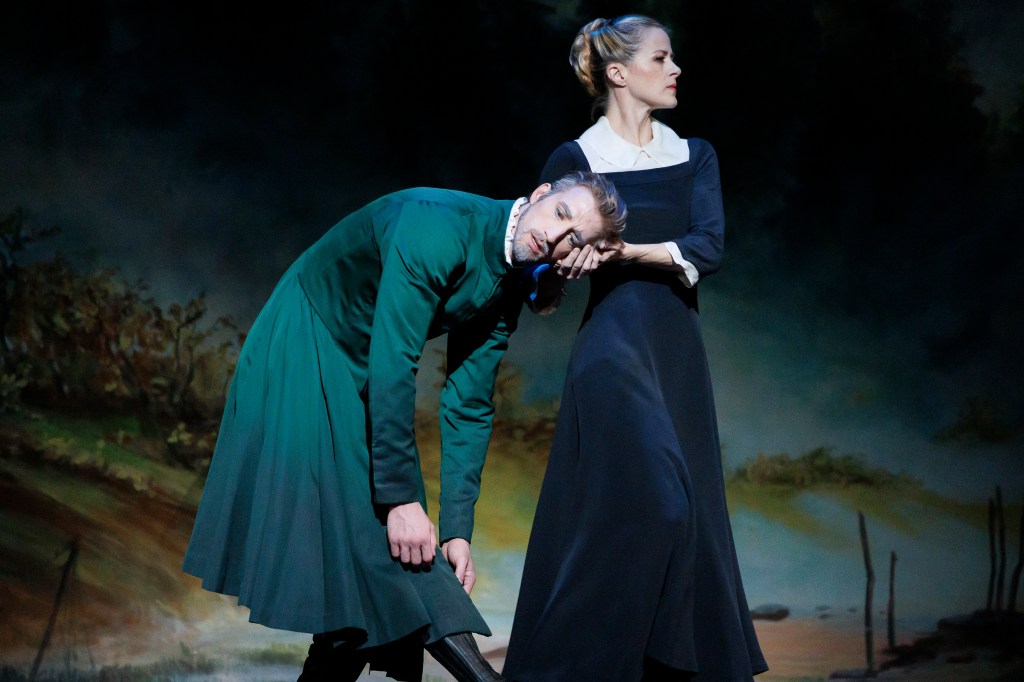
Courtesy of The National Ballet of Canada.
While Leontes “tears shed there/ Shall be my recreation” (3.2.236-237) in front of the statues, Paulina moves stage right, performing a series of petite arabesques in a circle almost to express the circularity of this ritual over sixteen years. Together Paulina and Leontes perform a synchronized duet, rolling onto the floor onto their knees with a leg bent behind them similar to Odette’s pose as The Dying Swan in Swan Lake with arms outstretched to the side as they bend their spines forward and back. In this way, they both share the grief and sorrow of Sicilia. Paulina begins to mimic the same sharp movement of her hands flat with fingers touching moving from left to right as Leontes does in Act I. When Leontes tries to leave, she leads him back to the statues. For as Wheeldon describes it, Paulina “in a way, kind of quietly behind [Leontes] reminds him of the horrors he has inflicted upon these two.”8 Leontes kneels in remorse as Paulina dances around him in a series of tour jetés and attitude turns. Leontes and Paulina in another synchronized duet gliding from stage left to stage right. When a courtier enters, Leontes places his head in Paulina’s hand once more. She carries him across the stage again to the statues where Leontes kneels, both their arms outstretched towards Mamillius and Hermione. Through synchronized duets repeated across the stage, Paulina conveys repentance as ongoing physical and emotional labour.
Act III: Paulina Solo
‘Tis time. Descend. Be stone no more. (5.3.99)
After it is discovered that Perdita is the long-lost Princess of Sicilia, Paulina leads Leontes to the statue of Hermione which comes to life. The play ends with Leontes as the last speaker in which he addresses Paulina:
LEONTES: Good Paulina,
Lead us from hence where we may leisurely
Each one demand and answer to his part
Performed in this wide gap of time since first
We were disservice. Hastily lead away. (5.3.151-155)
Even in Leontes’s last lines, Paulina continues to lead.
What strikes me in Wheeldon’s production is that Paulina has the last word. The rest of the ensemble exit the stage leaving Paulina alone. The audience watches her perform a solo rendition of the duet she and Leontes danced at the cliffside at the beginning of Act III. However, rather than exiting the stage, Paulina finishes downstage right on the floor, ending with her body folded towards the statue of Mamillius. This gesture is particularly important because even though Paulina reveals the statues of both Hermione and Mamillius, to use Gemma Miller’s words, “the double statue did not equal a double resurrection.”9 Paulina’s final bow towards Mamillius seems to acknowledge that redemption is partial and that restoration cannot erase the irreversible loss imprinted on the family. It is the refusal of uncomplicated closure that makes the ballet’s end so striking. In an ensemble as big as The Winter’s Tale, having a single dancer conclude the work is both unusual and deliberate.
Classical ballets typically end with a grand ensemble or a symmetrical tableau. However, ending The Winter’s Tale with a single dancer shifts the emphasis from celebration to reflection. Paulina as the sole dancer on stage reminds me of The Dying Swan in Swan Lake; The Chosen One alone in The Rite of Spring; and some productions of Albrecht alone at Giselle’s grave in Giselle. By having Paulina remain after the ensemble exits, it suggests that redemption does not erase the grief and history of Sicilia. Paulina remains that witness.
Seeing this performance has altered the way I understand Paulina. In Shakespeare’s The Winter’s Tale, Paulina often operates from the margins of political power; in Wheeldon’s production, she moves to choreographic centre. She physically confronts Leontes; guides him through his journey of grief; carries him (literally and symbolically) through repentance; marks the passage of time; and performs the final dance on stage. The production does not close on communal celebration, but on Paulina alone, her body folded toward loss. In doing so, Wheeldon resists a simple conclusion to redemption and instead focuses on the ballet’s most prominent witness. Paulina is the conscience of Sicilia: the character who remains and memorializes the events even as the curtain falls.
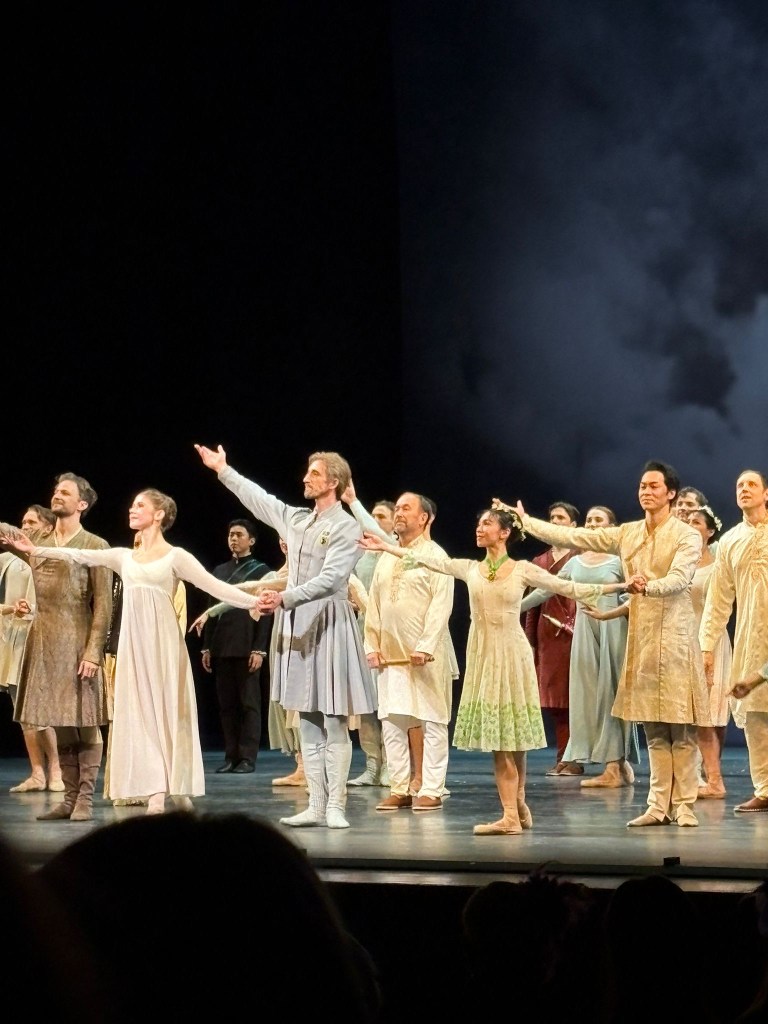
Photo by Chelsea Matson.
Acknowledgements
This review is the product of the generosity and support of many collaborators. My sincerest thanks goes to Chelsea Matson for providing images of the curtain call, and to Chelsea Cabello and Sarah Johnsen from National Ballet of Canada for sharing images of the performance. I am deeply grateful to the directors of The Shakespeare and Dance Project—Lynsey McCulloch, Linda McJannet, Amy Rodgers, and Emily Winerock—for creating this platform which I have closely followed and admired since I was an undergraduate student. To be able to contribute to this project is a dream come true. I especially extend my heartfelt thanks to Emily for our lovely correspondences during the writing of this review.
Endnotes
- See Zoë Anderson, “International Ballet: Crossing Boundaries” in The Ballet Lover’s Companion (New Haven, Yale University Press, 2015), p. 328. ↩︎
- I grew up watching Heather Ogden perform principal roles such as the Sugar Plum Fairy in The Nutcracker; Princess Aurora in The Sleeping Beauty; and seeing promotion images of her as Odette-Odile in Swan Lake. To witness her dance as Paulina in The Winter’s Tale now that I’m an adult made the performance even more special. I also had the privilege of watching her perform in Crystal Pite’s Flight Pattern (2017) on February 28, 2026. ↩︎
- For a detailed synopsis and overview of Wheeldon’s production, see Anderson, “International Ballet: Crossing Boundaries” in The Ballet Lover’s Companion, pp. 327-330 and “The Winter’s Tale”, National Ballet of Canada, accessed on February 9, 2025, https://national.ballet.ca/productions/2526/the-winters-tale/. ↩︎
- For scholarship on the ballet production of The Winter’s Tale as a ballet, see Elizabeth Klett, “The Concord of This Discord: Adapting the Late Romances for the Ballet Stage,” Borrowers and Lenders 10, no. 2 (May 2023): 1-11; Elizabeth Klett, “My Heart Dances: Choreographing light and dark in the late romances,” in Choreographing Shakespeare: Dance Adaptations of the Plays and Poems (New York: Routledge, 2020), pp. 166-188; Gemma Miller, “Introduction – Simulacrum and Surrogation: The Children of Christopher Wheeldon’s The Winter’s Tale (2014/16),” in Childhood in Contemporary Performance of Shakespeare (London: The Arden Shakespeare, 2020), pp. 1-22; and Steven Swarbrick, “Dancing with Perdita: The Choreography of Lost Time in The Winter’s Tale,” in The Oxford Handbook of Shakespeare and Dance, ed. Lynsey McCulloch and Brandon Shaw (New York: Oxford University Press, 2019), pp. 197-216. ↩︎
- I want to clarify that when Leontes performs his solo, Hermione and Polixenes are on stage moving among the statues. I say solo to convey how Leontes dances alone in the spotlight while the other two characters move in the background. ↩︎
- In Shakespeare’s play, Paulina isn’t introduced until Act 2 Scene 2. ↩︎
- See Royal Ballet and Opera, “The Royal Ballet rehearse The Winter’s Tale,” YouTube video, 36:07-36:14, January 30, 2018, https://www.youtube.com/watch?v=OFNcQHlJfr0. ↩︎
- See Royal Ballet and Opera, “The Royal Ballet rehearse The Winter’s Tale,” YouTube video, 36:24-36:32, January 30, 2018, https://www.youtube.com/watch?v=OFNcQHlJfr0. It is unclear whether Wheeldon means Hermione and Mamillius or Leontes and Paulina when he refers to “these two”, but both possibilities apply in this context. ↩︎
- Gemma Miller, “Introduction – Simulacrum and Surrogation: The Children of Christopher Wheeldon’s The Winter’s Tale (2014/16),” in Childhood in Contemporary Performance of Shakespeare (London: The Arden Shakespeare, 2020), p. 1. ↩︎
Works Cited
Anderson, Zoë. “International Ballet: Crossing Boundaries.” In The Ballet Lover’s Companion, pp. 270-333. New Haven: Yale University Press, 2015.
Miller, Gemma. “Introduction – Simulacrum and Surrogation: The Children of Christopher Wheeldon’s The Winter’s Tale (2014/16).” In Childhood in Contemporary Performance of Shakespeare, pp. 1-22. London: The Arden Shakespeare, 2020.
Royal Ballet and Opera. “The Royal Ballet rehearse The Winter’s Tale.” YouTube video, 1:21:48. January 30, 2018. https://www.youtube.com/watch?v=OFNcQHlJfr0.
Shakespeare, William. “The Winter’s Tale.” In The Norton Shakespeare, edited by Stephen Greenblatt et al., pp. 3121-3204. 3rd ed. New York: W. W. Norton & Company, 2016.
Citation
Chong, Grayson. “‘I’ll use that tongue I have’: Paulina as Conscience in Christopher Wheeldon’s The Winter’s Tale.” The Shakespeare and Dance Project, edited by Emily Winerock, May 4, 2026. https://shakespeareandance.com/articles/paulina-as-conscience-in-wheeldon-winters-tale/. Accessed [date].
Updated May 4, 2026.
2013-2026. All rights reserved. The Shakespeare and Dance Project.